Holm Cultram Abbey C of E Primary School
Phonics and Reading
At Holm Cultram Abbey CE Primary School, we use Read Write Inc Phonics (RWI) to give your child the best possible start with their Literacy development. Mrs Grierson is our Early Reading Leader and Mrs Watson is our English Subject Leader, so if you have questions about RWI, contact them through the school..
Reading at HCA
At Holm Cultram Abbey CE Primary School, we aim for all our children to become fluent, confident readers who are passionate about reading. Children who read regularly or are read to regularly have the opportunity to open the doors to so many different worlds!
More importantly, reading will give your child the tools to become independent life-long learners.
We can achieve this together through:
- Read Write Inc, a program to help your child read at school
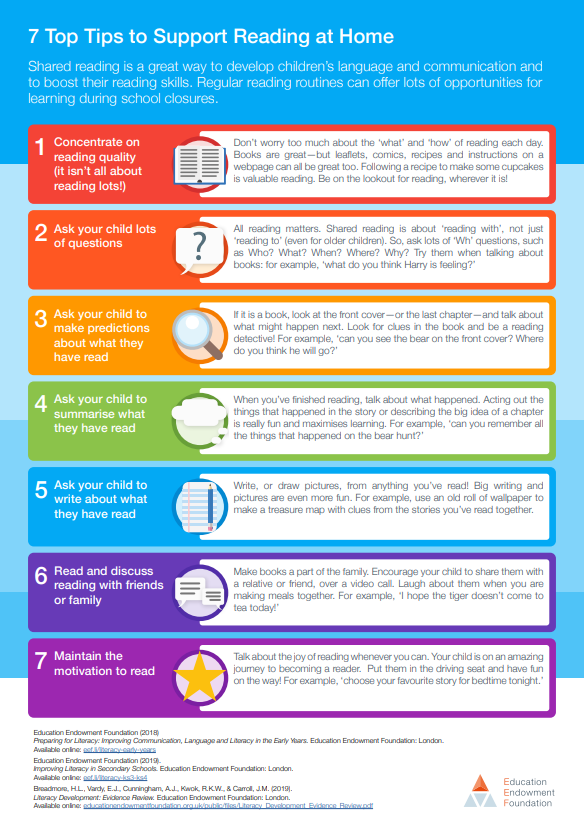
- Encouraging children to develop a love of books by reading to them daily, at home and at school
- Giving children access to a wide range of books at school and at home
What is Read Write Inc?
Read Write Inc (RWI) is a phonics complete literacy programme which helps all children learn to read fluently and at speed so they can focus on developing their skills in comprehension, vocabulary and spelling. The programme is designed for children aged 4–7. However, we continue teaching RWI to children beyond the age of 7 if necessary, as we use a stage not age approach.
How will my child be taught to read?
We start by teaching phonics to the children as soon as they are settled into Reception. This means that they learn how to ‘read’ the sounds in words and how those sounds can be written down. This is essential for reading, but it also helps children learn to spell well. We teach the children simple ways of remembering these sounds and letters.
Reading
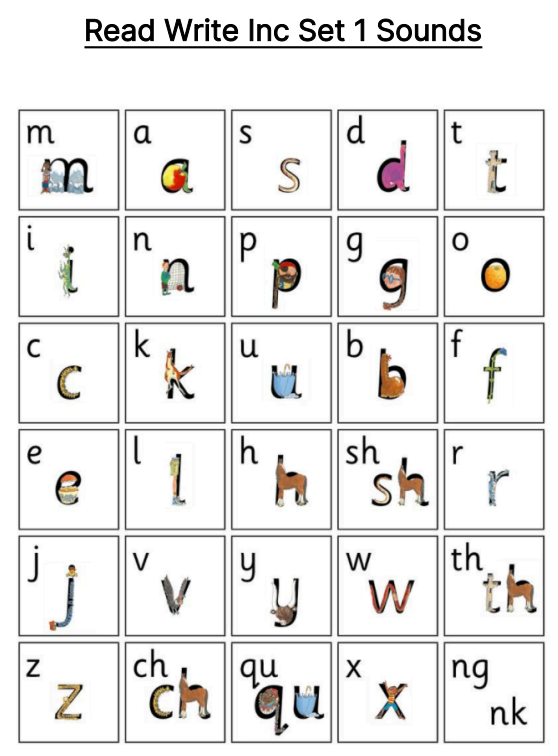 The children:
- Learn 44 sounds and the corresponding letters/letter groups using simple picture prompts.
- Learn to read words using Fred talk and sound blending
- Read from a range of storybooks and non-fiction books matched to their phonic knowledge
- Work well with partners
- Develop comprehension skills in stories by answering 'Find It' and 'Prove It' discussion questions
Progressing through the stages
Children follow the same format as they move through Key Stage One, but will work on complex sounds and read books appropriate to their reading level. Daily sessions of RWI phonics usually last about 30 minutes. Once children become fluent speedy readers, they will move on to chapter books assessed through Accelerated Reader.
Five key principles underpin the teaching in all Read Write Inc. sessions:
- Purpose – know the purpose of every activity and share it with the children, so they know the one thing they should be thinking about
- Participation – ensure every child participates throughout the lesson. Partnership work is fundamental to learning.
- Praise – ensure children are praised for effort and learning, not ability
- Pace – teach at an effective pace and devote every moment to teaching and learning
- Passion – be passionate about teaching, so children can be engaged emotionally.
Fred Talk
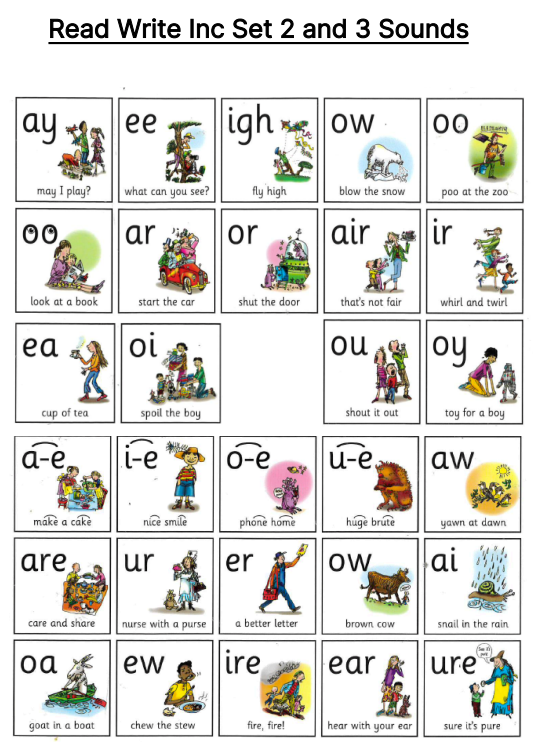

We use pure sounds (‘m’ not’ muh’,’s’ not ‘suh’, etc.) so that your child will be able to blend the sounds into words more easily.
At school, we use a puppet called Fred who is an expert at sounding out words!
We call it, ‘Fred Talk’. E.g. m-o-p, c-a-t, m-a-n, sh-o-p, b-l-a-ck.
This video explains how we will say the sounds in school.
Nonsense words (Alien words)
As well as learning to read and blend real words, children will have plenty of opportunities to apply their sound recognition skills to reading ‘nonsense words’. These words will also feature heavily in the Year One Phonics Screening check in the summer term. These words provide endless opportunities for children to apply and practice their thinking in a range of different contexts.
To help at home
Your child will start to bring books home when they are confident readers, relating to their reading stage. You will find they will bring home a phonics-based book. This will aid application, speed and fluency – developing speedy reading! Following on from this, they will bring a comprehension-based book which will begin to enrich their reading, which will require decoding skills. Only then will children bring home enriched reading books which will enhance their understanding via inspirational language promoting depth to their understanding.